


By FlavorWiki Insights Team
Published February 2026
Between new 2025-2030 Dietary Guidelines and the FDA’s 2026 Human Foods Program priorities, U.S. food regulation is evolving fast. And consumer expectations are evolving with it.
This shift is not just about compliance. It's a catalyst for better-for-you innovation, smarter labeling strategies, and gaining consumer trust. But only if product and insights teams act early.
Below, we break down what’s changing, what it means for your SKUs, and the key actions cross-functional teams should take now to stay ahead.
Quick Overview: What's Changing in 2026?
Dietary Guidelines
What’s New: First-ever warning to avoid highly processed foods
Why It Matters: Influences nutrition programs, labeling, and consumer behavior
Front-of-Pack (FOP) Labels
What’s New: Proposed FDA rule: mandatory display of added sugar, sodium, sat fat
Why It Matters: In-aisle decision-making will shift. Visibility = risk + opportunity
"Healthy" Claim Update
What’s New: New criteria: nutrient thresholds AND required food groups
Why It Matters: Many current "healthy" products no longer qualify
UPF Scrutiny
What’s New: Legal action + possible federal definition of ultra-processed foods
Why It Matters: May impact brand reputation, claims, and reformulation priorities
Front-of-Pack Labeling: Shelf Visibility Is About to Change
What’s happening?
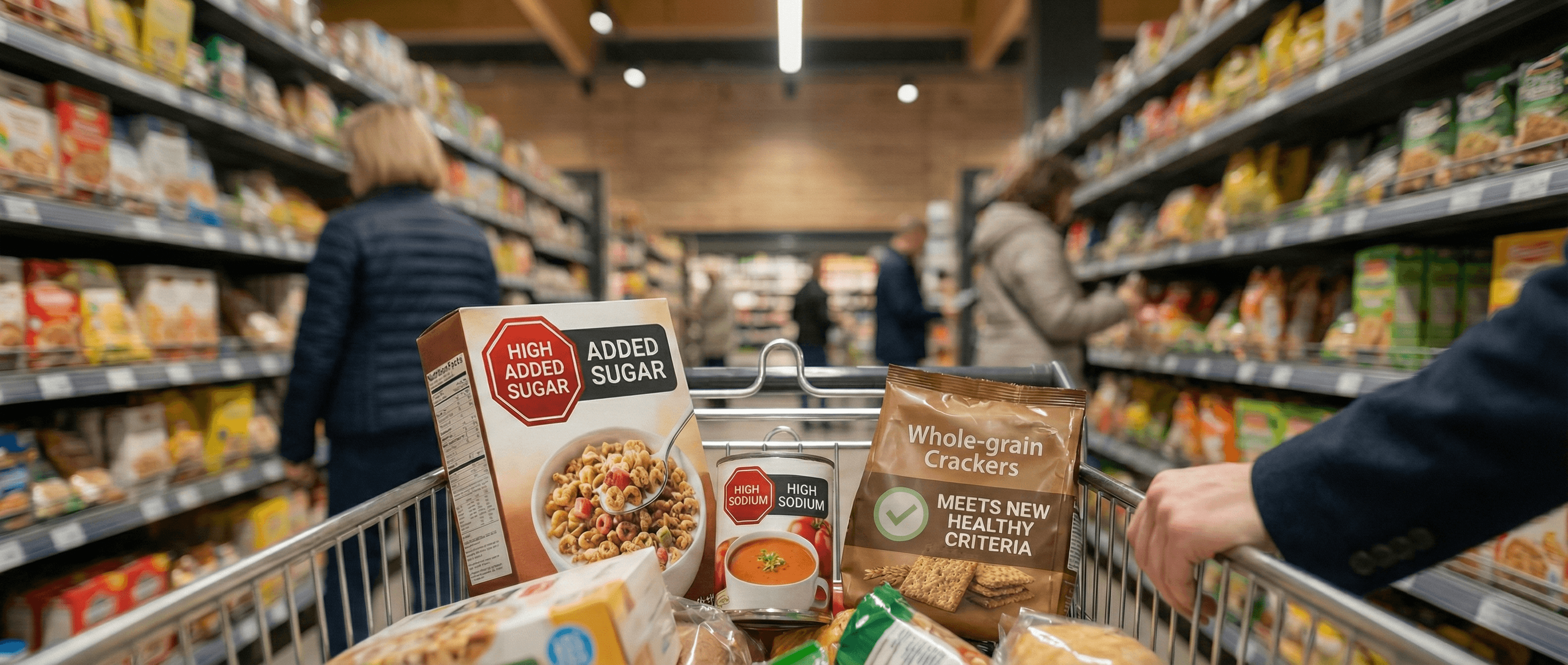
The FDA’s proposed rule would require key nutrient warnings on the front of packages, particularly for:
- Added sugar
- Sodium
- Saturated fat
These nutrients will be displayed visually (icons, color codes, or symbols) to simplify health comparisons.
Why it matters:
- Products high in sugar/sodium may carry negative cues to consumers.
- Retailers may prioritize or penalize based on FOP visibility.
✅ Action Checklist
- Audit all top-selling SKUs: Will they trigger front-of-pack warnings?
- Reevaluate pack design: Can you communicate benefits within tighter space?
- Test FOP perception with real consumers (before rollout).
New Definition of "Healthy": Stricter & Smarter
What’s changing?
To use the "healthy" claim, a food must:
- Stay under strict limits for sodium, added sugar, and saturated fat.
- Include at least one food group (e.g., fruit, veg, whole grains, lean protein).
Why it matters:
- Only a fraction of current "healthy"-labeled foods qualify under the new rule.
- The term is becoming a regulatory risk without reformulation or proof.
✅ Action Checklist
- Identify SKUs using (or wanting to use) “healthy” on-pack or digital.
- Reformulate where needed to meet nutrient + food group thresholds.
- Prepare compliant claims language
Added Sugar & Sodium Reduction: Now a Business Imperative
What’s happening?
The FDA is promoting stronger voluntary targets for:
- Added sugar reduction across beverages, cereals, snacks
- Sodium reduction in processed categories like soups, dressings, frozen meals
Why it matters:
- Retail buyers and investors now track nutrient improvement plans.
- High-sodium/high-sugar SKUs may struggle with FOP visibility, school eligibility, and public health pressure.
✅ Action Checklist
- Prioritize top-volume SKUs for salt/sugar reductions.
- Explore flavor compensation strategies: umami boosters, acid balancing, sweetness enhancers.
- Validate your reduced salt/sugar claims/positioning
Why validate? Because words matter and saying “Less” on pack, for example, can backfire:
Even when “less sugar” or “less sodium” is meant as a positive claim, it can carry unintended negative associations:
- Implied trade-off: Consumers may assume that “less” = worse taste, or a product that’s been compromised in some way.
- Deprivation framing: “Less” can trigger a subconscious sense of loss, even when the product is healthier.
- Taste vs. health tension: People say they want health, but they buy on taste, claims like “less” can subtly suggest they’ll be missing out.
Ultra-Processed Foods: Growing Legal & Reputation Risk
What’s shifting?
- The Dietary Guidelines now recommend Americans limit highly processed foods.
- Consumer awareness of UPFs is rising quickly (thanks to media + lawsuits).
- The FDA is researching a federal definition of ultra-processed foods.
Why it matters:
- “Clean label” claims may be challenged if product structures don’t back them up.
- Marketing language around natural, simple, or wholesome must be defensible.
✅ Action Checklist
- Conduct a UPF audit using NOVA or similar frameworks.
- Reframe your narrative: Focus on functionality of processing (e.g., food safety, shelf stability).
- Re-position claims and highlight consumer perception of or reformulated variants to;
- Highlight Ingredient Transparency such as; “Made with recognizable ingredients”
- Explain Purposeful Processing “Cold-pressed to preserve nutrients” or “Baked, never fried”
- Lean into Familiarity “Made like you would at home” or “Crafted with care”
Strategic Questions Every Team Should Ask
Whether you're in R&D, Marketing, or Consumer Insights - collaboration is key.
- Do our top 20 SKUs meet updated “healthy” criteria or risk negative FOP flags?
- Have we prioritized reformulation projects for sugar, salt, and ultra-processing?
- Are our claims and packaging teams aligned on upcoming labeling limits?
- Are we testing reformulations through robust consumer validation panels?
- Do we have a go-to-market narrative for “better-for-you” that’s legally sound and emotionally resonant?
Act Before It’s Mandated
The 2026 food regulations are not abstract, they’re a competitive reality. Smart brands are already reformulating, pressure-testing new claims, and piloting low-UPF launches.
Don’t wait until your packaging has to change. Use this moment to:
- Build cross-functional reformulation sprints
- Validate front-end innovation with consumer testing
- Future-proof your marketing language
Need a framework for cross-team readiness? We’re tracking regulation timelines, category innovation, and consumer response data.
Contact us to receive our FOP & Reformulation guidelines or to request a workshop with your team.